




Art Deco icons stand alongside fairytale‑worthy castles, as architecture weaves together classic and contemporary styles that shift across Oklahoma City’s historic districts. Much like food, architecture offers a meaningful way to explore the city and gain insight into its past. Design enthusiasts and travelers drawn to beautiful surroundings will find plenty to admire in OKC, including some of the must-see districts that exude their own unique style and character.
Castle Falls: European‑Inspired Charm
Nestled on a tree-lined hillside and inspired by an actual castle in Normandy, Castle Falls is like a real-life fairytale in the city. Constructed from salvaged materials, including pieces from the historic Colcord Hotel, the castle was the vision of Oklahoma City native and WWI veteran Bill Blecha, who began building his dream home in 1945. He lived there with his wife until his death in 1989, after which it housed a German restaurant, Keller in the Kastle, and eventually became a wedding venue.
Today, it’s one of the most transportive architectural attractions in OKC, with both an a la carte restaurant (The Cellar) and a tasting menu restaurant (The Primrose), along with guided history tours offered on the third Saturday of each month. Castle Falls also ranks among the city’s most magical wedding venues and regularly opens its doors to the public for special events, including themed dinners with magicians.
Spanish Revival in the Paseo Arts District
As one of OKC’s most colorful districts, the Paseo Arts District dazzles visitors with its galleries, boutiques and restaurants housed within striking Spanish Revival and Mission-style buildings. Dating to the 1920s and ‘30s, the neighborhood is both vibrant and unique, with pastel-hued structures containing more than 20 art galleries, as well as shops, bars and local eateries like Picasso Cafe and Goro Ramen. With its stucco facades, arched doorways and clay tiled roofs, the architecture lends a distinct artistic character that ties the past with the present.
Art Deco Touches in Midtown & City Center
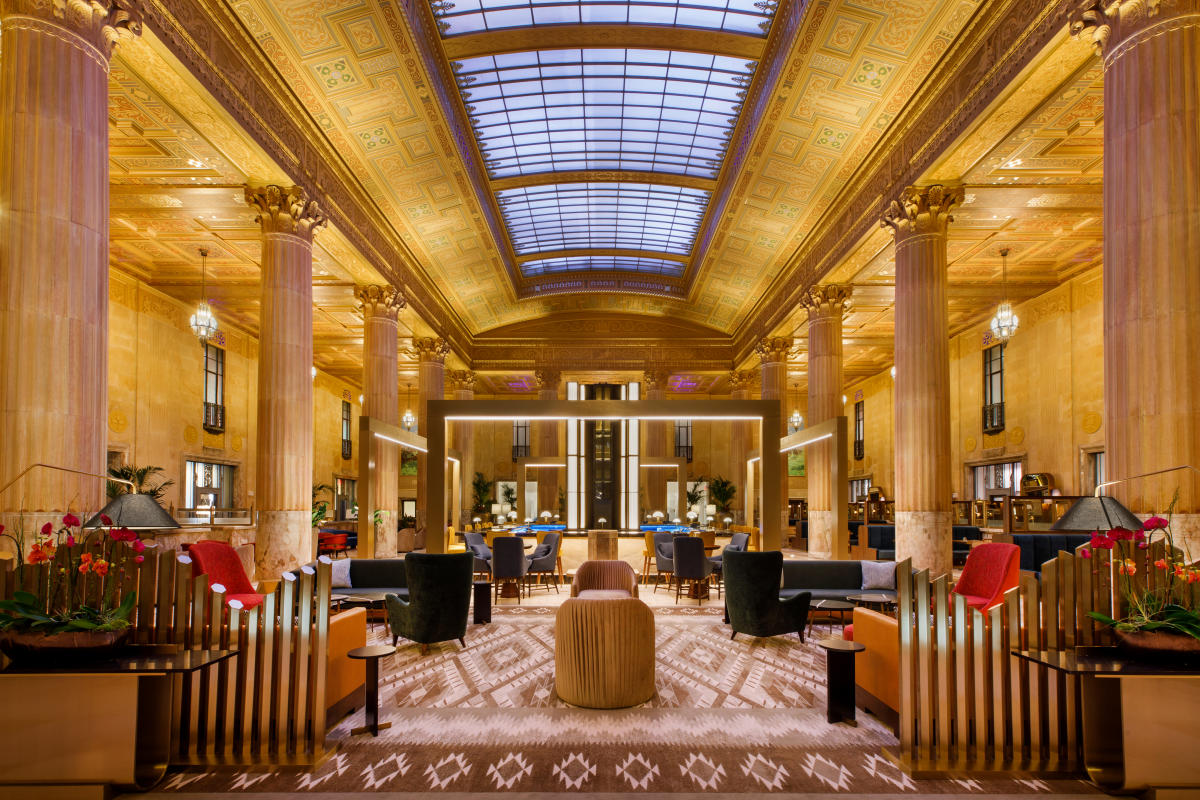
From a vintage train station to a soaring bank tower transformed into a boutique hotel, Art Deco is on full display throughout downtown and Midtown. Distinguished by its linear construction and sleek lines broken up by bold colors and creative shapes, the architectural style came to define mid-century urban design, as seen on many buildings in OKC.
Some examples are impossible to miss, like the 32-story First National Center. Originally constructed as a bank in 1931, the spire-clad skyscraper now contains residences, a hotel, high-end shops and restaurants, including Italian-inspired Tellers, lined with elegant Corinthian columns in the soaring Great Hall. In the basement, guests can sip cocktails inside the former bank vault, aptly named The Vault at The National.
Nearby, the Santa Fe Depot features a clock tower and terrazzo floors in a decadent limestone building constructed in 1934. Now serving as an Amtrak and bus station, and renovated in 2017, the beautifully preserved structure blends nostalgia with modern amenities while showcasing the history of Bricktown.
Additional downtown icons include the Civic Center Music Hall, a grand performance venue dating back to 1937, and City Hall, which pairs limestone and marble with a mix of Deco-era and Classical Revival influences. Both structures opened in the same year and remain notable civic landmarks.
Beyond major institutions, Art Deco appears across downtown and Midtown in both residential and commercial spaces. Highlights include homes along the 2500 block of NW 24th Street, former film studios transformed into commercial spaces on historic Film Row and Cheever’s Cafe, a beloved local restaurant set inside a late‑1930s flower shop, complete with terrazzo floors and black glass.
Discover OKC for Yourself
From food and sports to shopping and outdoor adventure, there are so many reasons to visit OKC and endless wonders to discover along the way. Architecture, whether it’s a sky-scraping tower lined with columns and cocktails or a tiled art gallery, is another great way to explore the city and connect with the history of its characteristic districts. Start planning your Oklahoma City getaway today.